
Sowbugs and pillbugs are among the small invaders most frequently observed around Quebec homes. Although often considered insects, they are actually terrestrial crustaceans, related to shrimps and crabs.
In Gatineau, Val-des-Monts, Cantley, Chelsea, and throughout the Outaouais region, sowbugs and pillbugs live primarily outdoors where they play an important role in the decomposition of organic matter.
They sometimes become a nuisance when they enter in large numbers into basements, garages, bathrooms, or other damp areas of the home.
Fortunately, their presence is generally more related to a moisture problem than to a true indoor infestation.
How can you identify a sowbug or pillbug?
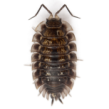
Sowbugs and pillbugs have a very distinctive appearance that generally makes them easy to identify.
Key characteristics include:
- Length generally ranging from 5 to 15 mm;
- Gray to grayish-brown coloration;
- Segmented, rigid exoskeleton;
- Seven pairs of legs;
- Slow movement.
Some species can also roll themselves into a tight ball when threatened.
They are commonly found:
- Under stones;
- Beneath mulch;
- Under pieces of wood;
- In gardens;
- Along foundations;
- In damp, shaded areas.
Why do sowbugs and pillbugs enter your home?
Sowbugs and pillbugs require moisture to survive.
They primarily seek:
- Humid environments;
- Dark locations;
- Decaying organic matter;
- Protection from heat and drought.
They may enter a home through:
- Foundation cracks;
- Door thresholds;
- Basement windows;
- Openings around utility lines;
- Poorly sealed gaps.
During periods of heavy rainfall or prolonged drought, they may seek shelter indoors.
However, conditions inside most homes are generally too dry to support long-term survival.
Are sowbugs and pillbugs dangerous?
Sowbugs and pillbugs are completely harmless to humans.
They:
- Do not sting;
- Do not bite;
- Do not transmit diseases;
- Do not damage building structures.
They primarily feed on decaying plant material and play an important role in the natural recycling of organic matter.
The main concern is simply their presence when they appear in large numbers indoors.
Why does the problem keep coming back?
Sowbugs and pillbugs will continue to be present as long as favourable conditions remain around the building.
The most common contributing factors include:
- Excess moisture near foundations;
- Accumulated dead leaves;
- Mulch placed directly against the home;
- Decaying wood;
- Poor drainage;
- Dense vegetation near the building.
Even if the individuals found indoors are removed, new sowbugs and pillbugs may continue entering from outside.
What should you do if you have sowbugs or pillbugs in your home?
In most cases, sowbugs and pillbugs found indoors can simply be removed with a vacuum cleaner.
To reduce their presence, we recommend:
- Reducing moisture around the building;
- Keeping mulch away from foundations;
- Removing accumulated dead leaves;
- Correcting drainage issues;
- Repairing cracks and openings;
- Improving basement ventilation.
These measures often significantly reduce their presence.
Our solution
At Maranda Pest Control, our approach focuses on identifying the conditions that contribute to sowbug and pillbug activity around your property.
Our inspection allows us to:
- Identify infiltration areas;
- Assess moisture-related issues;
- Identify favourable conditions around the home;
- Determine entry points;
- Recommend appropriate corrective measures.
Depending on the situation, various preventive strategies and control methods may be implemented to reduce existing populations and limit future intrusions.
Our goal is to correct the source of the problem rather than simply eliminate the visible individuals.
Need help with sowbugs or pillbugs?
Whether you are in Gatineau, Val-des-Monts, Cantley, Chelsea, L’Ange-Gardien, or anywhere in the Outaouais region, our team can identify the factors contributing to their presence and offer solutions tailored to your property.
Contact Maranda Pest Control for a professional inspection and reclaim a more comfortable home, free from sowbug invasions.