
Bumblebees are essential pollinating insects. They play an important role in the reproduction of flowers, fruit trees, gardens, and many agricultural crops.
In the majority of situations, their presence requires no intervention. Bumblebee nests should be preserved when they present no risk to property occupants.
However, when a nest is established inside a wall, floor, attic, or immediately adjacent to circulation areas, an intervention may sometimes become necessary to ensure the safety of occupants.
How can you identify a bumblebee?
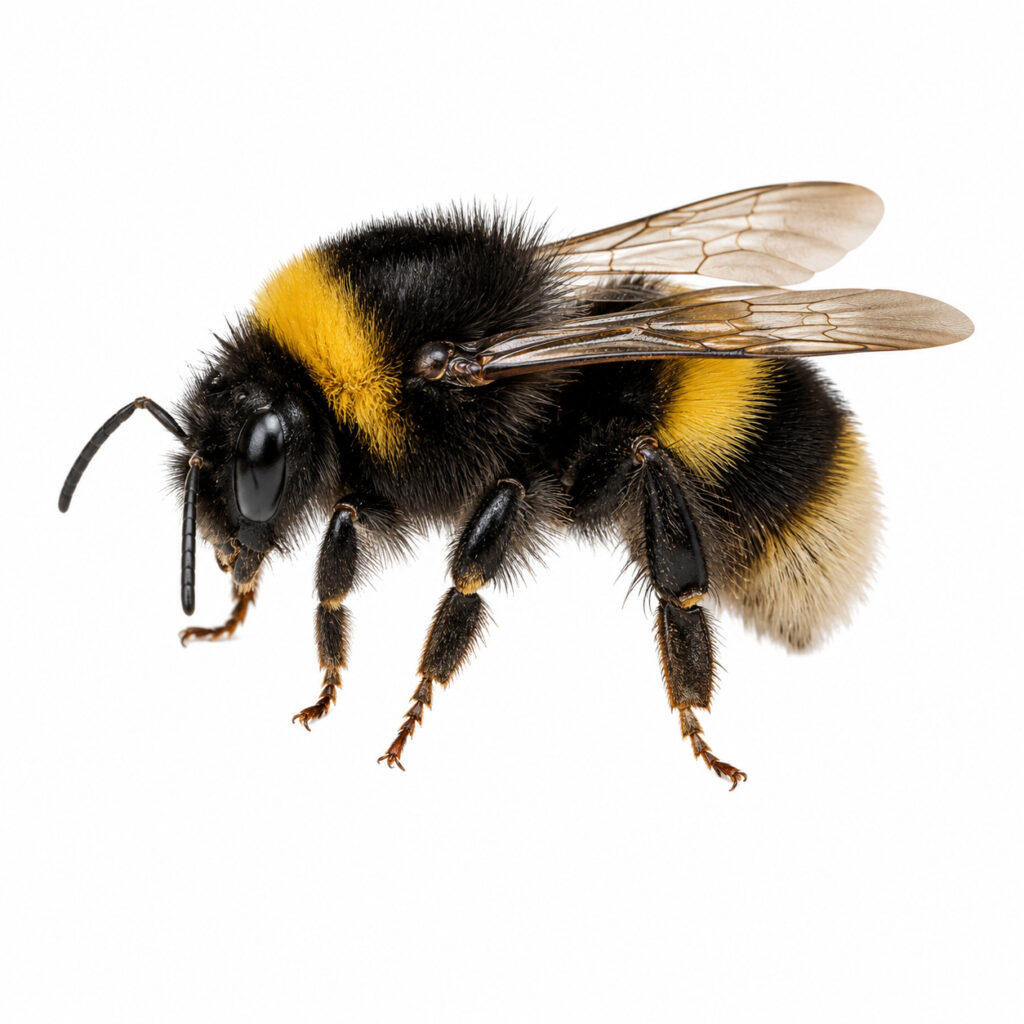
Bumblebees are often mistaken for certain bee species or even large wasps.
Key characteristics include:
- Size generally ranging from 7 to 25 mm;
- Robust, stocky body;
- Very hairy appearance;
- Black coloration combined with yellow, orange, or white bands depending on the species;
- Relatively slow and noisy flight.
Unlike wasps, a bumblebee’s body is covered with dense hair that allows it to efficiently collect and transport pollen.
Their nests are typically hidden:
- In the ground;
- Beneath structures;
- Inside wall voids;
- In certain construction cavities;
- Under sheds or decks.
Why do bumblebees nest on your property?
Bumblebees look for protected locations in which to establish their seasonal colonies.
They generally prefer:
- Natural cavities in the ground;
- Abandoned burrows of small animals;
- Protected spaces beneath structures;
- Certain cavities within walls or buildings.
A bumblebee colony is typically active from spring through late summer or early fall.
Unlike many other social insects, bumblebee colonies do not survive the winter. Only newly fertilized queens overwinter and establish new colonies the following year.
Are bumblebees dangerous?
Bumblebees are generally considered non-aggressive.
They prefer to devote their energy to collecting pollen and nectar rather than defending their nest.
However, like most bees, they can sting if they feel threatened or if their nest is disturbed.
The risk increases mainly when:
- The nest is located near an entrance;
- Children play nearby;
- Pets have access to the area;
- The nest is located inside a wall or a frequently used structure.
Individuals with bee sting allergies should always exercise caution when a nest is present near a residence.
Why can the problem become more significant?
When a nest is established inside a wall, ceiling, or another cavity within a building, it can sometimes lead to complications after the colony has died out.
Once abandoned, the organic materials that make up the nest may:
- Decompose over time;
- Attract certain species of flies;
- Encourage the presence of larder beetles;
- Attract other opportunistic insects.
This is why nests located within a building’s structure often require special attention.
What should you do if you have a bumblebee nest?
The first step is to determine whether the nest actually poses a risk.
In many situations, the best solution is simply to allow the colony to complete its natural life cycle.
However, intervention may be recommended when a nest is located:
- Inside a wall;
- In an attic;
- Directly adjacent to an entrance;
- In a frequently used area;
- Near children or pets.
It is generally best to avoid attempting to remove the nest yourself, as this can trigger a defensive response from the colony and make the situation more difficult to manage.
Our solution
At Maranda Pest Control, we always favour a responsible approach that recognizes the ecological importance of pollinators.
Our service begins with an inspection to:
- Correctly identify the species present;
- Assess the level of risk;
- Determine the location of the nest;
- Evaluate whether the colony can be left undisturbed;
- Recommend the most appropriate solution based on the situation.
When a nest is located within a building’s structure, we may use various detection methods, including specialized visual inspections and thermal imaging, to accurately determine its location.
Depending on the accessibility of the nest and the building’s constraints, different strategies can then be considered to resolve the problem while minimizing impacts on the structure and its occupants.
Our goal is always to recommend the safest and most appropriate solution for your specific situation.
Need help with a bumblebee nest?
Whether you are in Gatineau, Val-des-Monts, Cantley, Chelsea, L’Ange-Gardien, or anywhere in the Outaouais region, our team can help you identify the species present and determine whether an intervention is truly necessary.
Contact Maranda Pest Control for a professional inspection and receive tailored advice to protect your family while respecting the pollinators that contribute to our environment.