
Carpenter ants are among the most frequently observed insects in residences of Gatineau, Val-des-Monts, Cantley, Chelsea, and throughout the Outaouais region.
The appearance of a few ants inside may seem trivial, but it can sometimes reveal the presence of a nest established in the building structure or nearby.
Unlike many other ant species, carpenter ants can create galleries in wood in order to establish their colonies. This is why their presence deserves special attention, particularly when sightings become frequent.
How can you identify a carpenter ant?
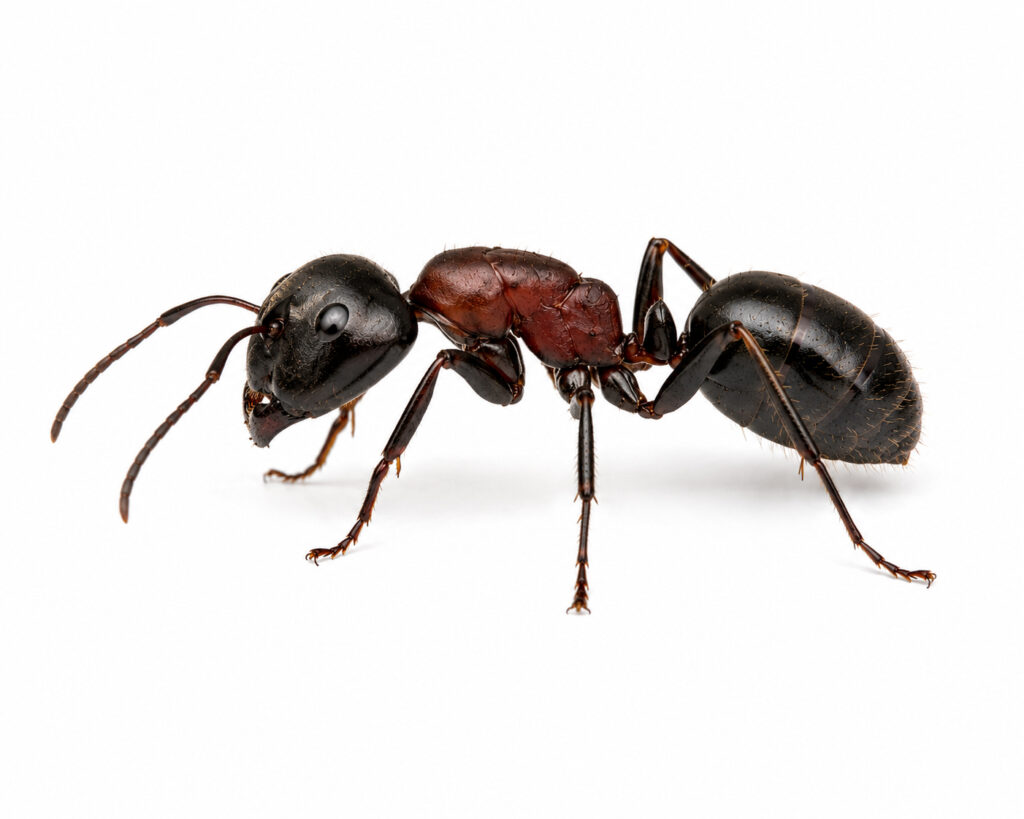
Carpenter ants are among the largest ant species found in Quebec.
Key identifying characteristics include:
- Workers generally range in size from 6 to 13 mm;
- Reproductive ants may reach up to 25 mm in length;
- Black or black-and-red coloration;
- Body divided into three distinct segments: head, thorax, and abdomen;
- Narrow waist between the thorax and abdomen;
- Elbowed antennae characteristic of ants.
Workers are primarily active during the evening and at night, although they may be observed at any time of day.
Why do carpenter ants invade your home?
Carpenter ants primarily seek secure locations in which to establish their colonies and protect their offspring.
A mature colony may consist of a main nest and several satellite nests. In some cases, a single colony may contain several thousand individuals spread across multiple locations.
Workers may travel hundreds of feet from the nest to:
- Search for food;
- Locate sources of moisture;
- Establish new satellite nests;
- Explore new territories.
Homes become particularly attractive when they contain:
- Moisture-damaged wood;
- Water infiltration issues;
- Insulated wall voids;
- Insulation materials such as rigid foam or spray foam;
- Structures that provide warmth and protection.
It is not uncommon for ants observed in a kitchen or bathroom to actually originate from a nest located elsewhere in the building or outdoors.
Are carpenter ants dangerous?
Carpenter ants generally do not pose a threat to human health.
However, they can cause damage when a colony remains active within a building for an extended period.
Contrary to popular belief, carpenter ants do not eat wood. They excavate it to create galleries that serve as shelter for their colony.
Potential damage may include:
- Progressive deterioration of affected wood;
- Enlargement of existing cavities;
- Damage to certain insulation materials;
- Creation of voids in thermal insulation;
- Increased heat loss;
- Increased risk of condensation within certain walls or ceilings.
The presence of carpenter ants may also indicate an underlying moisture or water infiltration problem that should be addressed.
Why does the problem keep coming back?
In many cases, the ants seen indoors represent only a small portion of the colony.
As long as a main nest or satellite nest remains active, workers will continue moving through the home even after temporary treatments have been applied.
Store-bought insecticides may sometimes provide short-term relief, but they often have a repellent effect that temporarily disperses the ants without eliminating the colony at its source.
This is why many homeowners notice ants returning a few weeks or months after a do-it-yourself treatment.
The key to long-term success lies in locating the nest and developing a strategy tailored to the situation.
What should you do if you have carpenter ants in your home?
The first step is to determine whether the ants are coming from:
- A nest located inside the building;
- An outdoor nest near the home;
- A satellite colony established within a wall, ceiling, or attic.
This distinction is essential because treatment methods vary considerably depending on the source of the infestation.
The sooner the nest is located, the greater the likelihood of resolving the problem effectively.
Observing large numbers of ants in the spring, particularly while outdoor temperatures are still cool, is often an indication of an indoor nest.
Our solution
At Maranda Pest Control, every service begins with a comprehensive evaluation to determine the nest location and the most effective elimination strategy.
Our inspection allows us to:
- Identify areas of activity;
- Determine where the ants are coming from;
- Identify factors contributing to the infestation;
- Assess risks to the building structure;
- Recommend appropriate preventive measures.
When the nest is located outdoors, we can implement targeted treatments designed to reduce activity around the building and limit future intrusions.
When a nest is located within the structure, we generally favour localized treatments applied directly to the infested areas. This approach provides fast results while minimizing product application within living spaces.
Because every situation is different, several strategies may be used depending on the season, building configuration, and colony location.
Because carpenter ant infestations commonly become noticeable in the spring, we offer warranties of up to 18 months to ensure the next critical season is covered.
Need help with a carpenter ant problem?
Whether you are in Gatineau, Val-des-Monts, Cantley, Chelsea, L’Ange-Gardien, or anywhere in the Outaouais region, our team can quickly identify the source of the problem and implement an effective strategy to eliminate the colony.
Contact Maranda Pest Control for a professional inspection and protect your residence against damage caused by carpenter ants.