
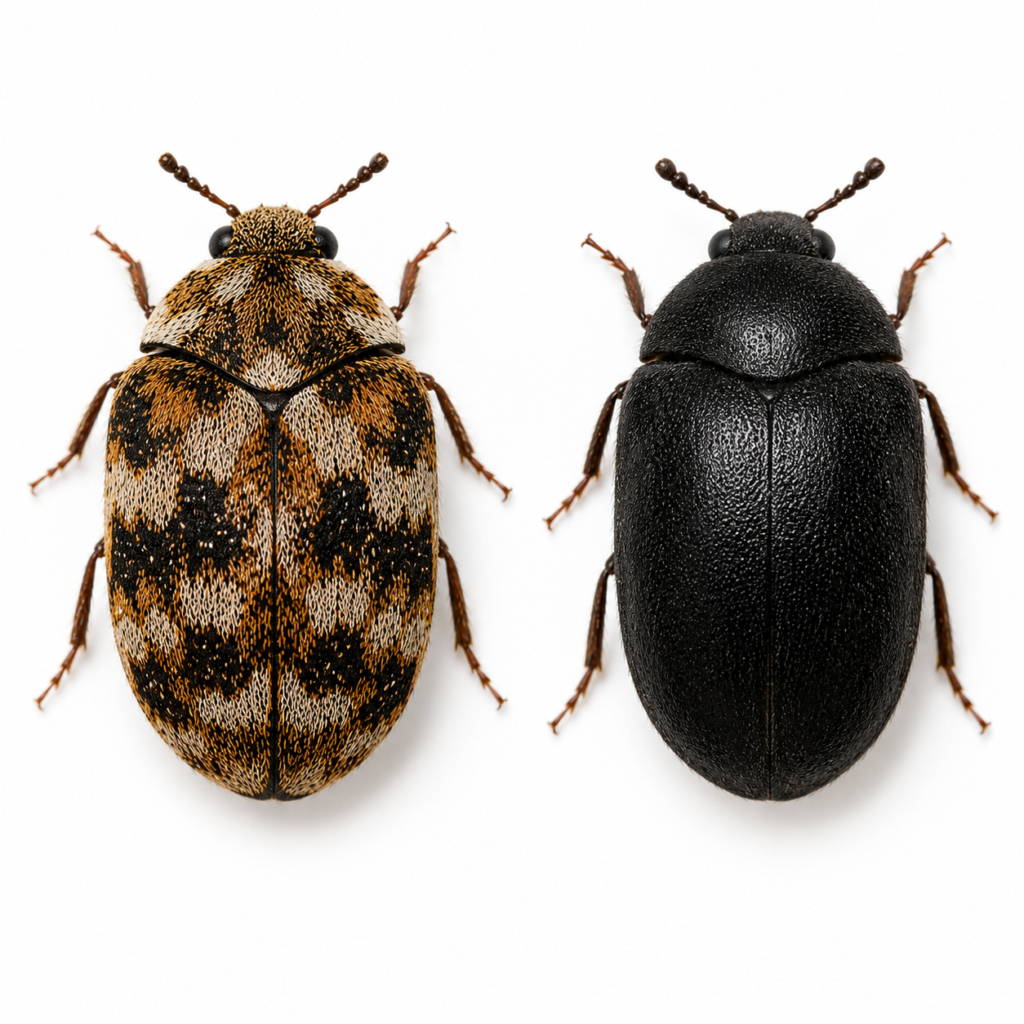
The carpet beetle is a small beetle frequently found in residences, apartments, and commercial buildings. Although adults are generally harmless, larvae can cause significant damage to certain textiles and animal-based materials.
In Gatineau, Val-des-Monts, Cantley, Chelsea, and throughout the Outaouais region, infestations often go unnoticed until the discovery of holes in clothing, rugs, or stored fabrics.
Since larvae hide in dark, infrequently visited places, the problem may be present for several months before being detected.
How can you identify a carpet beetle?
The carpet beetle belongs to the dermestid family, just like the larder beetle.
Adult
- Approximately 3 to 5 mm in length;
- Oval-shaped body;
- Dark brown to black coloration;
- Smooth, shiny appearance;
- Slow-moving.
Larva
- May reach approximately 5 to 8 mm in length;
- Brown to golden-brown coloration;
- Hairy appearance;
- Elongated body resembling a small caterpillar;
- Presence of longer hairs at the rear end.
The larvae are responsible for most of the damage observed in homes.
Why do carpet beetles invade your home?
Carpet beetle larvae seek materials that contain animal-based fibers or organic matter.
They may feed on:
- Wool;
- Felt;
- Fur;
- Feathers;
- Natural-fiber carpets;
- Clothing containing animal fibers;
- Certain upholstered furniture;
- Accumulated pet hair and human hair.
They are often found in:
- Closets;
- Basements;
- Storage areas;
- Under furniture;
- Behind baseboards;
- In carpets that are rarely moved.
Adults are sometimes observed near windows because they are attracted to light.
Are carpet beetles dangerous?
Carpet beetles generally do not pose a threat to human health.
They:
- Do not sting;
- Do not bite;
- Do not transmit diseases.
The primary concern is the material damage caused by the larvae.
Larvae may damage:
- Carpets;
- Clothing;
- Blankets;
- Natural textiles;
- Collections containing animal-based materials.
Damage often appears as small irregular holes or areas of damaged fibers.
Why does the problem keep coming back?
Infestations usually persist when larvae continue to find a food source within the home.
Factors that contribute to their presence include:
- Dust accumulation;
- Pet hair accumulation;
- Textiles that are rarely moved;
- Storage areas that are infrequently cleaned;
- Accessible natural fibers.
Because larvae hide in low-traffic areas, they can remain active for long periods without being noticed.
What should you do if you have carpet beetles?
If you notice hairy larvae or discover damage to your textiles, it is important to act quickly.
We recommend:
- Inspecting carpets and clothing;
- Vacuuming regularly;
- Cleaning storage areas;
- Checking stored natural-fiber textiles;
- Reducing the accumulation of hair and dust.
A thorough inspection often helps identify the areas where larvae are developing.
Our solution
At Maranda Pest Control, our service begins with a comprehensive inspection to identify infestation sources and affected materials.
Our assessment allows us to:
- Confirm the species present;
- Identify development areas;
- Evaluate the extent of the problem;
- Search for food sources;
- Recommend appropriate corrective measures.
Depending on the situation, various control strategies can be implemented to eliminate existing larvae and prevent future damage.
We also provide preventive recommendations to help protect textiles and other sensitive materials.
Need help with carpet beetles?
Whether you are in Gatineau, Val-des-Monts, Cantley, Chelsea, L’Ange-Gardien, or anywhere in the Outaouais region, our team can quickly identify the source of the infestation and offer a tailored solution.
Contact Maranda Pest Control for a professional inspection and protect your rugs, clothing, and textiles against carpet beetle damage.