
The case-bearing clothes moth is a small, discreet moth whose larvae can cause significant damage to animal-based textiles in a residence.
In Gatineau, Val-des-Monts, Cantley, Chelsea, and throughout the Outaouais region, this species often goes unnoticed until holes appear in certain garments, rugs, blankets, or fabric items.
Contrary to many other nuisance insects, it is not the adult moths that cause the damage, but the larvae that feed on natural fibres.
The case-bearing clothes moth gets its name from the small protective case it builds and carries during its development.
How to identify a case-bearing clothes moth?
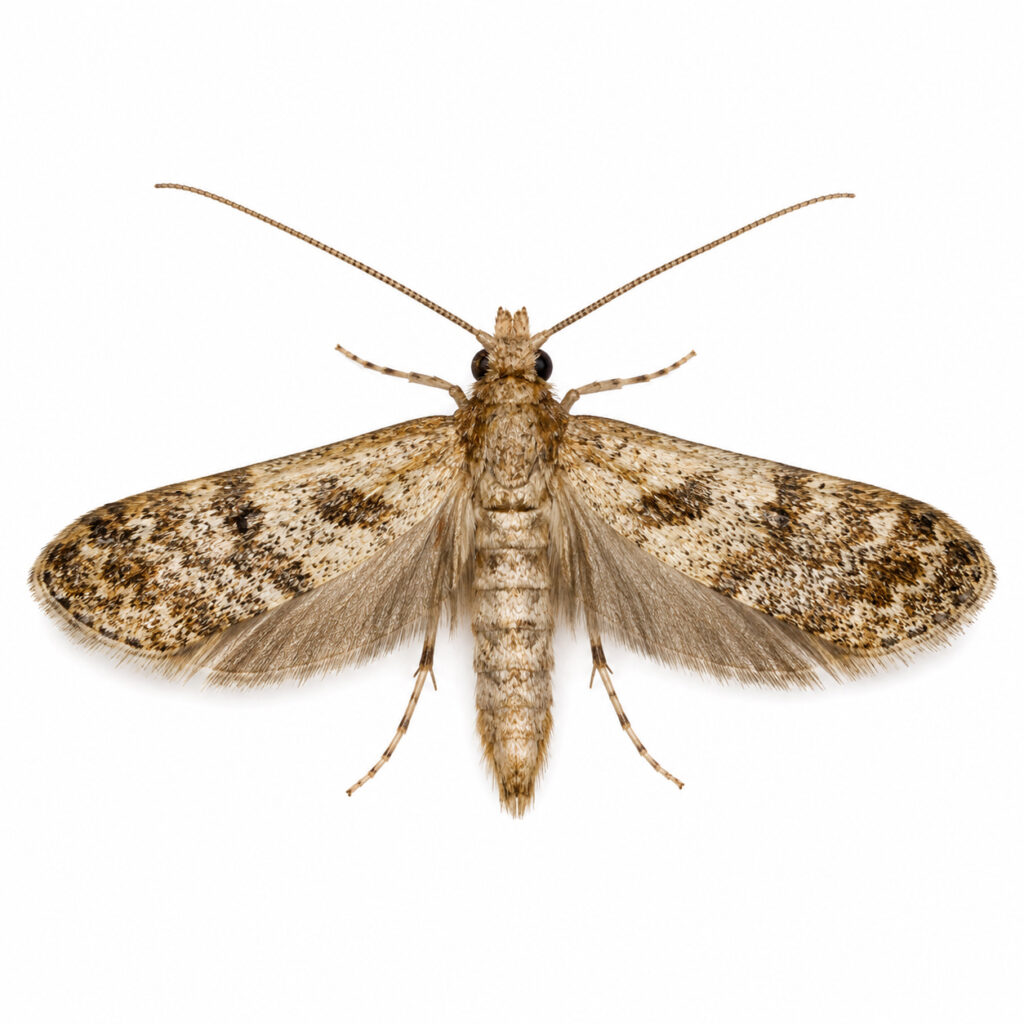
The case-bearing clothes moth is a very small, discreetly coloured moth.
Adult moth
- Length: approximately 5 to 7 mm;
- Wingspan: approximately 10 to 15 mm;
- Beige to pale brown colour;
- Uniform appearance with no distinct markings;
- Weak, irregular flight.
Larva
- Small whitish caterpillar;
- Brownish head;
- Carries a small silken case or sheath built from fibers and debris.
This mobile case is one of the best indicators for identifying this species.
Why do case-bearing clothes moths invade your home?
Case-bearing clothes moth larvae are primarily attracted to materials containing animal-based fibres.
They commonly feed on:
- Wool;
- Cashmere;
- Felt;
- Feathers;
- Fur;
- Certain natural-fibre carpets and rugs;
- Rarely used textiles.
Infestations are often encouraged by:
- Closets that are rarely accessed;
- Basements;
- Storage areas;
- Textiles stored for long periods of time;
- Dark, undisturbed locations.
The larvae generally prefer materials that also contain organic residues such as:
- Human hair;
- Pet hair;
- Skin flakes;
- Accumulated dust.
Are case-bearing clothes moths dangerous?
Case-bearing clothes moths pose no danger to human health.
They do not sting, bite, or transmit diseases.
The main problem lies in the damage they can cause to textiles, including wool garments, coats, rugs, blankets, natural fabrics, and decorative items containing animal fibers.
Damage is often only discovered when holes become visible.
Why does the problem keep coming back?
Infestations often persist when a food source remains available.
The most common contributing factors include:
- Clothing that is rarely worn;
- Carpets or rugs that are seldom moved;
- Dust accumulation;
- Stored textile items;
- Areas that are difficult to clean.
Because the larvae develop away from light and in low-traffic areas, they can remain unnoticed for several months.
Without a thorough inspection, some infestation sources may continue producing new generations.
What should you do if you have case-bearing clothes moths?
If you notice small beige moths or damage to your textiles, it is important to act quickly.
The following measures may help limit further damage:
- Inspect clothing and textiles made from natural fibres;
- Vacuum closets and storage areas thoroughly;
- Clean affected carpets and fabrics;
- Store clothing in airtight containers;
- Wash or dry-clean infested items.
However, once an infestation is established, it can be difficult to locate all breeding sites without a comprehensive inspection.
Our solution
At Maranda Pest Control, our intervention begins with a complete inspection to identify the source of the infestation and affected materials.
We provide tailored recommendations to protect valuable clothing, rugs, and textiles against future damage.
Need help with case-bearing clothes moths?
Whether you are in Gatineau, Val-des-Monts, Cantley, Chelsea, L’Ange-Gardien, or anywhere in the Outaouais region, our team can quickly identify the source of the problem and implement an effective strategy to protect your textiles.
Contact Maranda Pest Control for a professional inspection and prevent the damage caused by case-bearing clothes moths from spreading to your valuable garments and fabrics.