
House centipedes, centipedes, and millipedes are occasional invaders commonly found in homes throughout Quebec. Although they are often confused because of their many legs, these arthropods have very different behaviours.
In Gatineau, Val-des-Monts, Cantley, Chelsea, L’Ange-Gardien, and throughout the Outaouais region, they are most often found in basements, garages, bathrooms, and other damp areas of the home.
Their presence can be alarming, especially when they suddenly appear in large numbers or move quickly across a room. Fortunately, they rarely pose a danger to occupants.
How can you identify a house centipede, a centipede, or a millipede?
Although they may look similar at first glance, several characteristics make them easy to distinguish.
House centipedes and centipedes
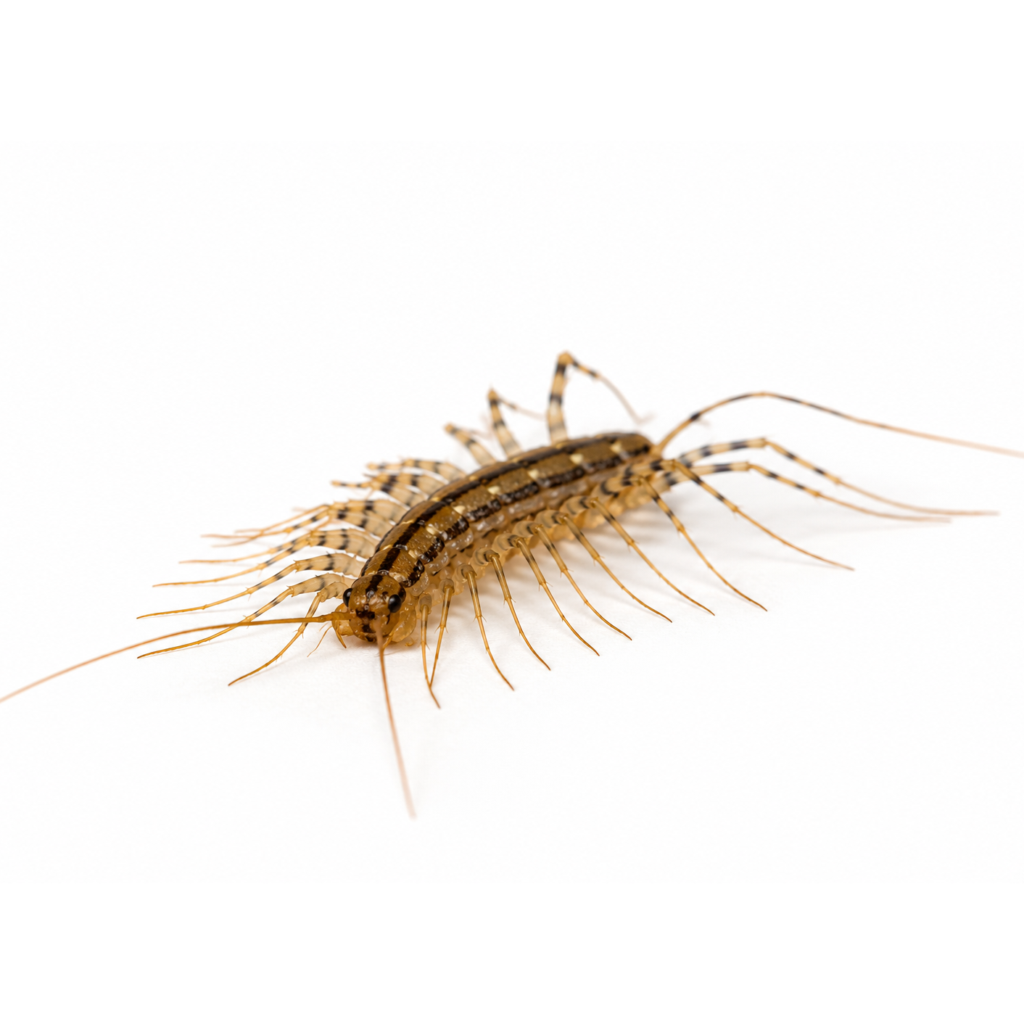
House centipedes are the centipedes most commonly found inside homes.
They can be identified by:
- Flattened, segmented body;
- Yellowish-gray to brown coloration;
- Very long, slender legs;
- Long antennae;
- Extremely fast movement;
- One pair of legs per body segment.
The house centipede has an almost hairy appearance because of its long legs and can reach several centimetres in length.
Millipedes
Millipedes have a noticeably different appearance:
- Cylindrical, rounded body;
- Dark brown to black coloration;
- Numerous pairs of legs distributed along the entire body;
- Slow movement;
- Tendency to curl into a spiral when disturbed.
Unlike centipedes, millipedes are not predators and feed primarily on decaying organic matter.
Why are they found inside homes?
House centipedes, centipedes, and millipedes generally seek conditions that favour their survival.
They are attracted to:
- Damp environments;
- Dark, undisturbed areas;
- Basements and crawl spaces;
- Garages;
- Storage areas;
- Cracks and openings in foundations.
Millipedes normally live outdoors in:
- Mulch;
- Dead leaves;
- Compost;
- Gardens;
- Beneath rocks and pieces of wood.
They often enter homes during periods of heavy rain, drought, or seasonal changes.
Centipedes and house centipedes, on the other hand, primarily enter homes in search of shelter and food.
Are house centipedes and centipedes beneficial?
Yes.
Unlike many other household pests, centipedes and house centipedes are beneficial predators.
They feed on:
- Ants;
- Spiders;
- Silverfish;
- Cockroaches;
- Flies;
- Other small insects.
Their presence can sometimes indicate that another insect population is present within the building.
Are they dangerous?
In the vast majority of cases, no.
Millipedes:
- Do not bite;
- Do not sting;
- Do not transmit diseases;
- Do not damage buildings.
However, some species may release a mild odour or secrete a defensive fluid when handled or crushed.
Centipedes and house centipedes
Centipedes possess venomous claws used to capture prey.
However:
- Bites are very rare;
- They generally occur only when the insect is handled directly;
- They rarely pose any serious risk to humans.
The primary concern is their intimidating appearance and their presence inside the home.
Why does the problem keep coming back?
When house centipedes, centipedes, or millipedes are regularly observed inside a home, favourable conditions are often present.
The most common contributing factors include:
- Excess moisture;
- Poor drainage;
- Accumulations of dead leaves;
- Mulch placed directly against foundations;
- The presence of other insects;
- Poorly ventilated basements;
- Cracks in foundations;
- Unsealed entry points.
As long as these conditions remain, new individuals may continue to enter the building.
What should you do if you find them in your home?
When sightings are occasional, they can generally be removed using a vacuum cleaner.
To reduce their presence over the long term, we recommend:
- Reducing moisture levels inside the building;
- Correcting water infiltration problems;
- Improving ventilation;
- Removing accumulated dead leaves;
- Keeping mulch away from foundations;
- Correcting drainage issues;
- Sealing cracks and openings;
- Controlling other insects present in the home.
These measures often significantly reduce future intrusions.
Our solution
At Maranda Pest Control, our approach begins by identifying the factors that contribute to the presence of house centipedes, centipedes, or millipedes.
Our inspection allows us to:
- Identify the species involved;
- Locate areas of entry;
- Assess moisture-related issues;
- Search for other insect activity;
- Evaluate exterior conditions around the building;
- Identify contributing environmental factors;
- Recommend appropriate corrective measures.
Depending on the situation, various prevention and control strategies can be implemented to reduce existing populations and limit future intrusions.
Our goal is always to address the root cause of the problem rather than simply eliminating the visible individuals.
Need help with centipedes or millipedes?
Whether you are in Gatineau, Val-des-Monts, Cantley, Chelsea, L’Ange-Gardien, or anywhere in the Outaouais region, our team can identify the causes of the problem and offer solutions tailored to your property.
Contact Maranda Pest Control for a professional inspection and regain peace of mind in the face of these sometimes impressive but generally harmless invaders.