
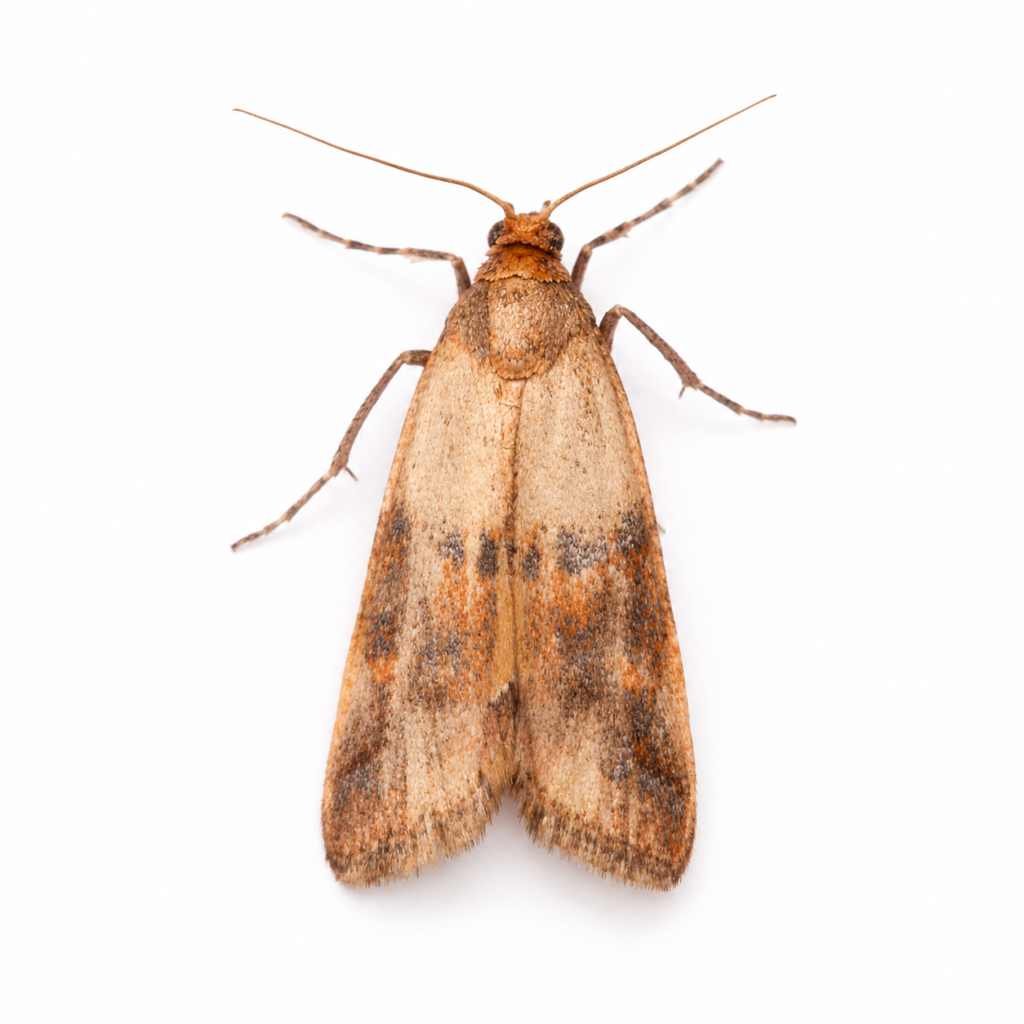

Indian meal moth problem in Gatineau, Val-des-Monts or the Outaouais region?
The Indian meal moth is the most commonly encountered pantry moth in Quebec residences. When small moths are spotted in the kitchen or pantry, this species is very often responsible.
In Gatineau, Val-des-Monts, Cantley, Chelsea, and throughout the Outaouais region, infestations generally begin when a contaminated food product is introduced into the home. Once established, larvae can quickly spread to multiple stored foods.
How to identify an Indian meal moth?
Adult moth
- Wingspan: approximately 15 to 20 mm;
- Front portion of wings: beige or pale grey;
- Rear portion of wings: reddish-brown or coppery;
- Very distinctive two-toned appearance;
- Primarily active in the evening and at night.
Larva
- Small whitish to cream caterpillar;
- Sometimes slightly pink or greenish depending on food;
- Brownish head;
- Length up to approximately 12 mm.
Larvae often produce fine silken webbing inside infested foods. They can infest: flour, cereals, rice, pasta, nuts, seeds, dried fruit, spices, baked goods, dog and cat food, and bird seed.
Why do Indian meal moths invade your home?
Indian meal moths are primarily attracted to nutrient-rich dry food products that provide a suitable environment for their larvae to develop.
They may infest:
- Flour;
- Cereals;
- Rice;
- Pasta;
- Nuts;
- Seeds;
- Dried fruits;
- Spices;
- Bakery products;
- Dog and cat food;
- Bird seed.
An infestation often begins when a contaminated product is purchased and stored in a pantry.
The larvae may then spread to other nearby food products.
Are Indian meal moths dangerous?
Indian meal moths generally do not pose a direct threat to human health.
They:
- Do not sting;
- Do not bite;
- Do not damage the structure of a building.
However, they contaminate the food products in which they develop.
The most common signs of an infestation include:
- Small larvae present in food products;
- Silk webbing inside packaging;
- Cocoons in cupboards and pantries;
- Moths flying around the kitchen;
- Clumped or contaminated food products.
Infested products should generally be discarded to eliminate the source of the problem.
Why does the problem keep coming back?
Even after visible adult moths have been eliminated, the infestation may continue if the food source remains present.
The most common causes include:
- An infested package forgotten in a cupboard;
- Contaminated pet food;
- Rarely used food products;
- Larvae hidden in pantry corners and crevices;
- Food stored in non-airtight containers.
The larvae may also leave food products to pupate in cracks, trim, or cabinet corners before reappearing as adult moths.
What to do if you have pantry moths?
If you observe moths in your kitchen, we recommend: inspecting all dry foods, checking open and closed packages, looking for larvae or webbing, discarding contaminated products, thoroughly cleaning cupboards, vacuuming cracks and corners, and storing foods in airtight containers.
Our solution
At Maranda Pest Control, our intervention begins with a complete inspection of the pantry and food storage areas. Our goal is to eliminate the source of the problem rather than simply the visible moths.
Need help with Indian meal moths?
Contact Maranda Pest Control for a professional inspection and durably rid yourself of pantry moths invading your kitchen.