
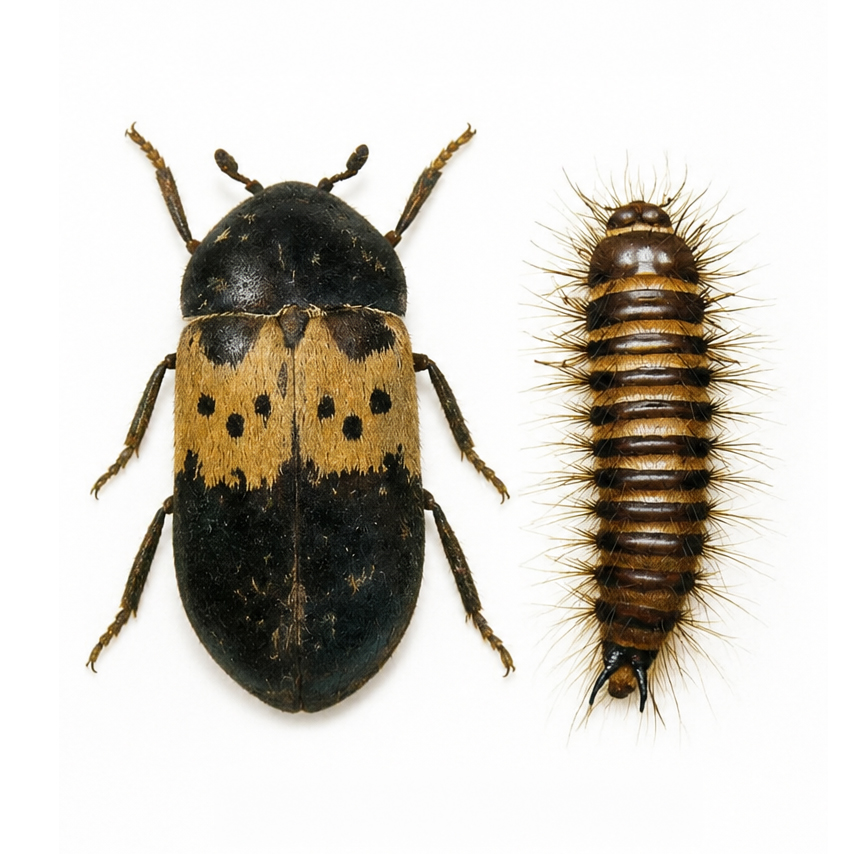

The larder beetle is a small beetle often discovered when an infestation is already well established. Although little known to the general public, this insect is frequently associated with the presence of animal-based organic matter in a residence or building.
In Gatineau, Val-des-Monts, Cantley, Chelsea, and throughout the Outaouais region, larder beetles can be observed in homes, attics, basements, garages, or commercial buildings.
In many cases, their presence indicates that a hidden food source is somewhere in the structure.
How to identify a larder beetle?
The larder beetle is a small beetle that is easy to identify once you know its characteristics.
Adult
- Length: approximately 7 to 10 mm;
- Oval body;
- Black or dark brown colour;
- Wide beige or yellowish band on the back;
- Several small black spots on this pale band.
Larva
- Brown to dark brown body;
- Hairy or fuzzy appearance;
- Elongated shape;
- Tufts of hair at the rear end.
The larvae are often more noticeable than the adults, as they spend more time feeding.
Why do larder beetles invade your home?
Larder beetles primarily feed on dry or decomposing animal matter.
They may be attracted to:
- Rodent carcasses;
- Dead birds;
- Dead insects accumulated inside walls;
- Bird nests;
- Abandoned rodent nests;
- Certain animal-based food products;
- Hunting trophies or biological collections.
It is not uncommon to see larder beetles appear several weeks after an animal dies inside a wall, attic, or roof void.
They may also be observed following the accumulation of large numbers of dead ladybugs, flies, or other insects within a structure.
Are larder beetles dangerous?
Larder beetles generally do not pose a direct threat to human health.
They:
- Do not sting;
- Do not bite;
- Do not transmit any known diseases.
However, they can damage materials that contain animal-based products.
The larvae may feed on:
- Fur;
- Feathers;
- Leather;
- Taxidermy mounts;
- Insect collections;
- Certain natural textiles.
Their presence often indicates an underlying issue that should be addressed.
Why does the problem keep coming back?
Larder beetles will continue to develop as long as a food source remains available.
The most common causes include:
- An inaccessible dead animal;
- An abandoned nest;
- An accumulation of dead insects;
- Hidden organic matter;
- A forgotten food source.
Even if visible insects are eliminated, new generations will continue to emerge as long as the source remains present.
This is why insecticide treatments alone rarely provide a permanent solution.
What should you do if you have larder beetles?
The first step is to identify the source that is feeding the larvae.
We recommend:
- Checking attics and roof spaces;
- Looking for signs of rodents or birds;
- Inspecting hard-to-reach areas;
- Removing organic material whenever possible;
- Keeping a few specimens to assist with identification.
Because the source is often hidden inside a wall void or another inaccessible area, a professional inspection may be necessary.
Our solution
At Maranda Pest Control, our approach focuses first on identifying the true cause of the infestation.
Our inspection allows us to:
- Confirm the species present;
- Identify activity areas;
- Search for food sources;
- Determine the origin of the problem;
- Recommend appropriate corrective measures.
Depending on the situation, various strategies can be implemented to eliminate the insects present and, most importantly, remove the source that is allowing them to develop.
Our goal is to resolve the problem at its source and prevent the infestation from returning.
Need help with larder beetles?
Whether you are in Gatineau, Val-des-Monts, Cantley, Chelsea, L’Ange-Gardien, or anywhere in the Outaouais region, our team can quickly identify the origin of the problem and implement an appropriate solution.
Contact Maranda Pest Control for a professional inspection and discover why these insects are appearing in your residence before the infestation grows.