
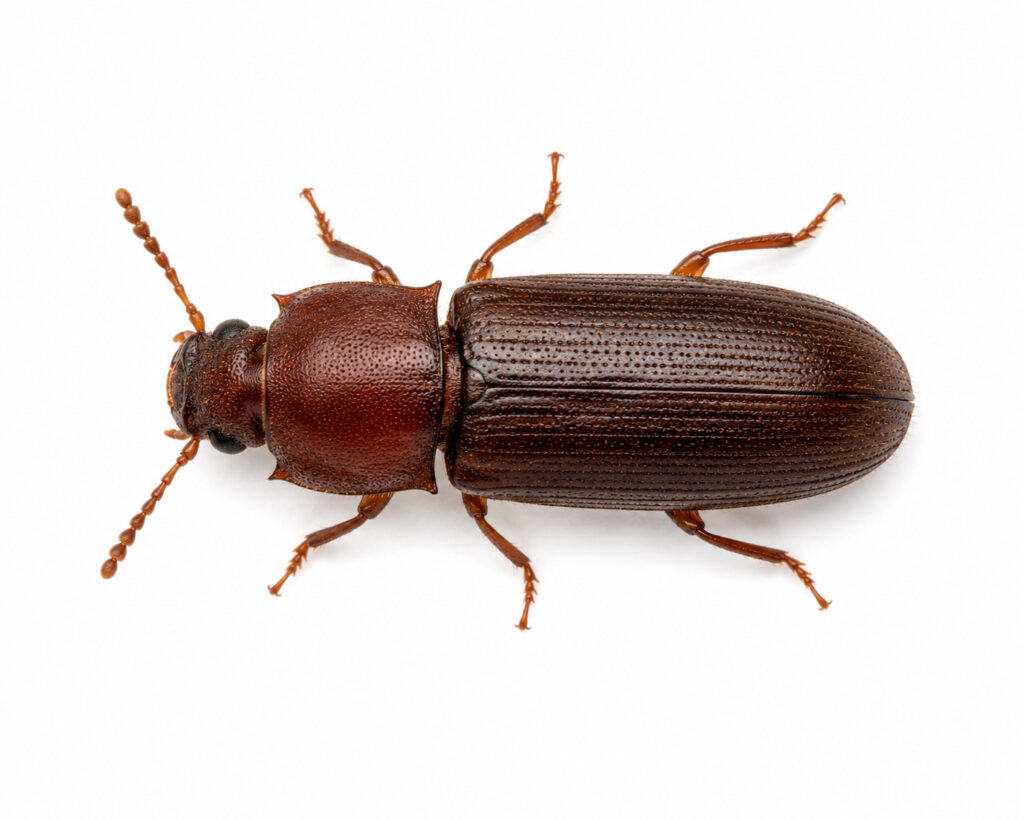

Discovering small insects in flour, cereals, rice, or pet food is more common than one might think. Several beetle species can infest dry foods stored in kitchens, pantries, and food warehouses.
In Gatineau, Val-des-Monts, Cantley, Chelsea, and throughout the Outaouais region, these infestations generally originate from a product already contaminated at the store or stored for a long time.
Unlike pantry moths, which are often noticed because of the small moths flying in the kitchen, pantry beetles often go unnoticed until their population becomes significant.
How can you identify a pantry beetle?
Several species can infest dry food products, including:
- Flour beetles (Tribolium spp.);
- Sawtoothed grain beetles;
- Drugstore beetles;
- Grain weevils;
- Various other stored-product beetles.
Although they differ in appearance, they often share several common characteristics:
- Size generally ranging from 2 to 6 mm;
- Light brown to dark brown coloration;
- Oval or elongated body shape;
- Slow movement;
- Presence directly within food products or kitchen cabinets.
The larvae are often more difficult to detect because they develop inside or near infested food items.
Why do pantry beetles invade your pantry?
These insects primarily seek nutrient-rich dry food products to feed their larvae.
They may infest:
- Flour;
- Cereals;
- Rice;
- Pasta;
- Seeds;
- Nuts;
- Dried fruits;
- Spices;
- Dog and cat food;
- Bird food.
Infestations often begin when an already contaminated product is brought into the home.
The insects then spread to other accessible food sources.
Are pantry beetles dangerous?
Pantry beetles generally do not pose a direct threat to human health.
They:
- Do not sting;
- Do not bite;
- Do not damage the structure of a building.
However, they contaminate the food products they infest.
Common signs include:
- Insects inside food packaging;
- Larvae in food products;
- Unusual powder or residue;
- Clumped food products;
- Insect activity inside cabinets.
Contaminated products should generally be discarded.
Why does the problem keep coming back?
Most infestations persist because an infested food source remains present.
Common causes include:
- A forgotten package in a cupboard;
- Rarely used food products;
- Pet food;
- Bird seed;
- Non-airtight storage containers.
Even when many insects are eliminated, a single overlooked source can allow the infestation to continue for weeks or even months.
What should you do if you find insects in your food?
The first step is to carefully inspect all dry food products.
We recommend:
- Checking all opened and unopened packages;
- Looking for insects or larvae;
- Discarding contaminated products;
- Thoroughly cleaning cabinets;
- Vacuuming cracks and corners;
- Storing food in airtight containers.
A thorough inspection is essential because the source of the problem is often harder to locate than most people expect.
Our solution
At Maranda Pest Control, our approach begins with a comprehensive inspection of food storage areas.
Our assessment allows us to:
- Identify the species present;
- Locate infested food products;
- Evaluate the extent of the infestation;
- Identify sources of contamination;
- Recommend appropriate corrective measures.
In most cases, identifying and eliminating the food source are the most important steps toward achieving long-term control.
We can also recommend preventive measures to help reduce the risk of future infestations.
Need help with pantry beetles?
Whether you are in Gatineau, Val-des-Monts, Cantley, Chelsea, L’Ange-Gardien, or anywhere in the Outaouais region, our team can quickly identify the insect responsible and help you eliminate the source of the problem.
Contact Maranda Pest Control for a professional inspection and reclaim a clean pantry free of insects.