
Every year, many homeowners in Gatineau, Val-des-Monts, Cantley, Chelsea, and throughout the Outaouais region notice the presence of wasps or bees that seem to enter and exit alone from a hole in a wall, soffit, garage, or exterior feature.
Unlike social wasps, these insects generally do not live in colonies and do not build large nests containing hundreds of individuals.
In the majority of cases, they are solitary wasps or bees — often beneficial insects that participate in pollination or natural control of pest insects.
Their presence can however become a concern when they settle directly on a building or near circulation areas.
How can you identify a solitary wasp or solitary bee?
Solitary wasps and solitary bees include many different species whose appearance can vary considerably.
Depending on the species, they may be:
- Black;
- Brown;
- Yellow and black;
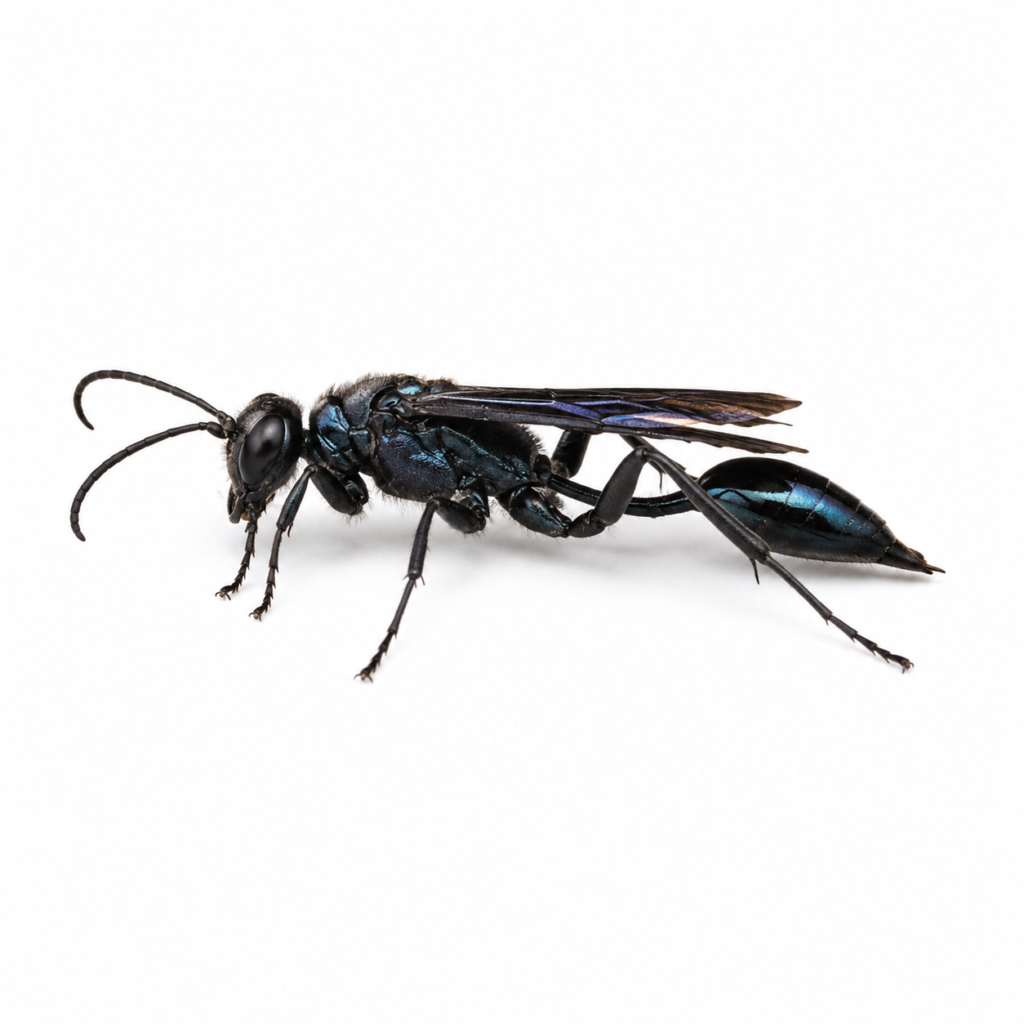
- Metallic blue;
- Metallic green;
- More or less hairy.
Their size generally ranges between:
- 12 and 25 mm.
One of the most commonly observed species is the mud dauber wasp, which often displays black, black-and-yellow, or metallic blue coloration.
Unlike social wasps, you will typically observe:
- Only one individual at a time;
- Little or no group activity;
- No heavy traffic in and out of a nest.
Why do solitary wasps and bees nest on your property?
These insects seek safe locations in which to lay their eggs and ensure the development of their offspring.
Depending on the species, they may use:
- Cracks in walls;
- Holes in wood;
- Natural cavities;
- Outdoor structures;
- Attics;
- Soffits;
- Garden sheds.
Mud dauber wasps are particularly well known for building small mud chambers attached to protected surfaces.
Inside each chamber, they place:
- An egg;
- A food reserve;
- Typically a paralyzed insect or spider that will feed the larva after it hatches.
Once development is complete, the new adult emerges from its chamber and continues its life cycle.
Are solitary wasps and bees dangerous?
In most cases, solitary wasps and bees are far less aggressive than social wasps or hornets.
Because they do not defend colonies containing hundreds of individuals, they generally have little interest in attacking when disturbed.
However, they may sting if:
- They are handled;
- They feel trapped;
- Their nest is directly disturbed.
For most people, a sting causes a localized reaction similar to that of a common bee or wasp.
Individuals who are allergic to insect stings should always exercise caution.
Why do solitary wasps and bees return every year?
Some species frequently return to the same areas when they find favourable conditions.
Factors that contribute to their presence include:
- Available nesting cavities;
- Surfaces protected from the weather;
- The presence of flowers and pollinator-friendly plants;
- An abundance of insects that serve as food for their larvae.
Mud structures and former nesting sites may also attract new females from one season to the next.
What should you do if you have solitary wasps or bees?
Before taking action, it is important to determine whether these insects actually pose a risk.
In many situations, their presence is temporary and does not require treatment.
However, intervention may be considered when:
- Nests are built inside a building;
- The insects are present near an entrance;
- Occupants have insect sting allergies;
- Daily activities are being disrupted;
- The number of nests becomes significant.
It is best to avoid destroying nesting structures before the species has been properly identified.
Our solution
At Maranda Pest Control, we always begin by accurately identifying the species involved.
Our inspection allows us to:
- Determine whether the insect is a solitary wasp or solitary bee;
- Assess the level of risk;
- Locate nesting sites;
- Identify factors contributing to their presence;
- Recommend appropriate measures.
In many situations, no intervention is necessary and simple preventive recommendations are sufficient.
When nests are located within a structure or pose a risk to occupants, we can recommend appropriate solutions to resolve the problem safely and effectively.
Need help with solitary wasps or bees?
Whether you are in Gatineau, Val-des-Monts, Cantley, Chelsea, L’Ange-Gardien, or anywhere in the Outaouais region, our team can identify the species present and advise you on the best approach to take.
Contact Maranda Pest Control for a professional inspection and receive recommendations adapted to your situation while respecting the beneficial insects that contribute to our environment.